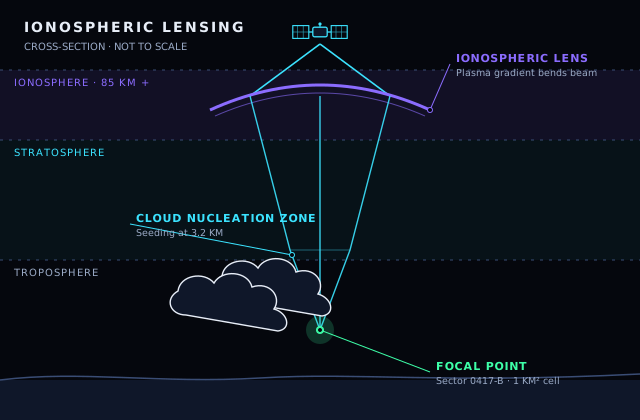
Coherent Nucleation Beam
CNB
A collimated beam of coherent radiation, bent by Ionospheric Lensing onto a nucleation zone 3.2 kilometres above the surface. Water vapour that was previously undecided commits to becoming cloud in roughly forty seconds.

Orbital atmospheric control · Now in public trial
1,212 satellites. One ledger. Your weather, delivered to the square kilometre.
Figures cover the trailing twelve months of Ledger operations and are attested by the Office of Ledger Integrity.
Procedure
Four steps, one confirmation. From request to delivered conditions in under ten seconds of your attention.
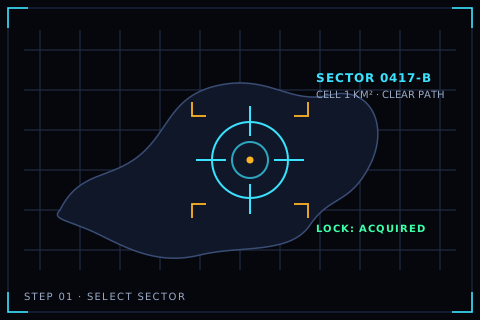
Place the reticle anywhere on Earth. The Canopy resolves your request to a single one-square-kilometre sky-cell, addressed by coordinate and held in the Atmospheric Allocation Ledger.
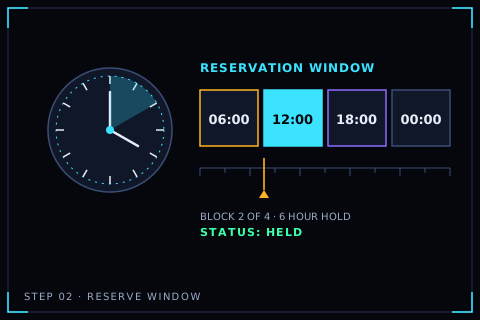
Choose one of four six-hour blocks. Each sky-cell can hold exactly one reservation per block, so the Ledger checks for conflicts before it promises you anything.
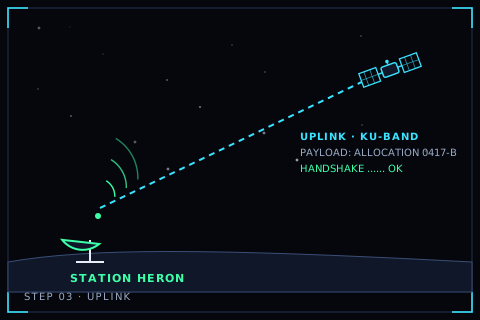
One of five ground stations, each named for a bird, transmits your reservation to three Stratoweaver satellites. Handshake completes in under a second. Nobody has ever had to wait for a bird.
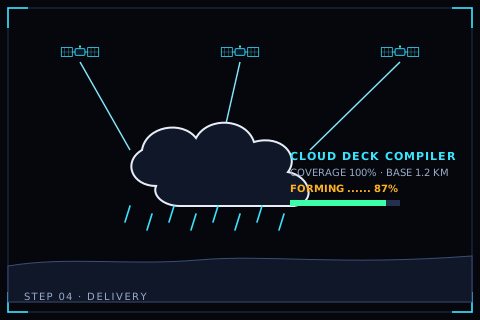
Three beams converge. The cloud deck is compiled in place and locked for the full window. You receive a numbered ticket stamped by the Ledger. Fulfilment confidence: 100%.
Constellation
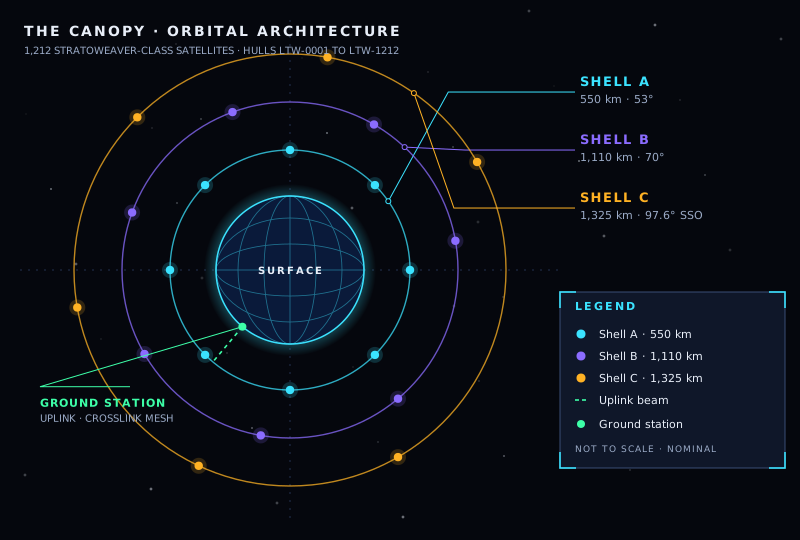
1,212 Stratoweaver-class satellites in three coordinated shells. Every point on the surface passes beneath at least three of them at all times, which is the minimum required for triangulation and the reason we chose the number.
| Constellation | 1,212 satellites, hulls LTW-0001 to LTW-1212 |
|---|---|
| Shell A | 550 km · 53° inclination |
| Shell B | 1,110 km · 70° inclination |
| Shell C | 1,325 km · 97.6° sun-synchronous |
| Cell resolution | 1 km² per sky-cell |
| Allocation window | 6 hours · four blocks per day |
| Beam dwell | 11 min average |
| Ground segment | Lapwing-4, Osprey-2, Plover-7, Harrier-3, Shrike-9 |
| Ledger fulfilment | 100.00% |
Technology
Everything the Canopy does is the product of four cooperating systems, each developed in-house and none available for inspection.
CNB
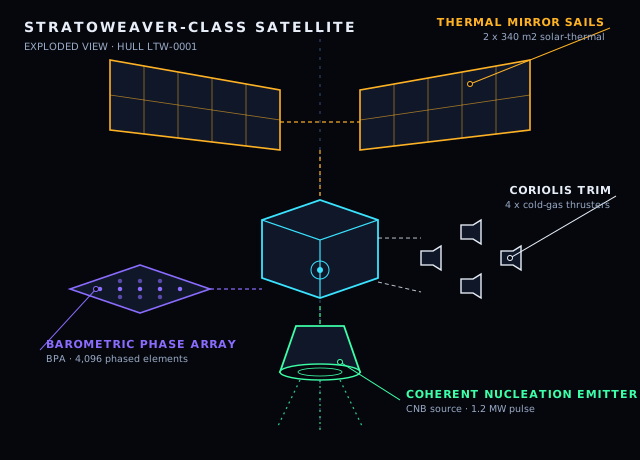
A collimated beam of coherent radiation, bent by Ionospheric Lensing onto a nucleation zone 3.2 kilometres above the surface. Water vapour that was previously undecided commits to becoming cloud in roughly forty seconds.
BPA
Each Stratoweaver carries a 4,096-element array. Operating in concert across three hulls, the arrays perform Isobar Sculpting, shaping pressure gradients to a tolerance of 0.1 hectopascal. Thermal Mirror Sails and Coriolis Trim handle the rest.
CDC
Translates a requested condition into a deck: a layered schedule of cloud base, thickness, droplet spectrum and onset time. Compilation completes in under nine seconds. Linking is slower, which is why every reservation is a six-hour window.
AAL
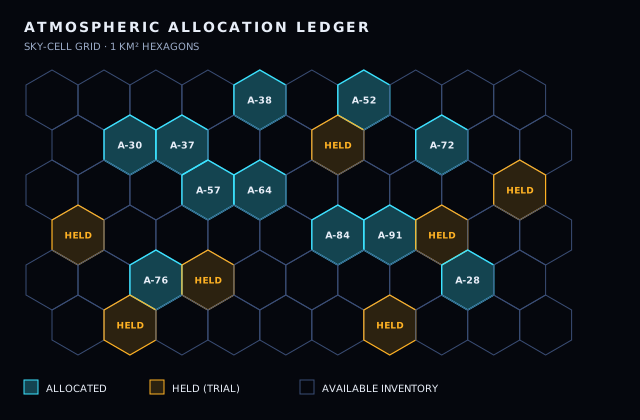
The Atmospheric Allocation Ledger holds one reservation per sky-cell per six-hour block. Never two. It is the reason the Canopy can promise what it promises, and the reason entries, once made, are final under Ledger Protocol 7.
Catalogue
Nineteen conditions, each with a protocol designation. Standard allocations are drawn from the Ledger's general inventory. Signature Events are reserved for members.
Our story
Atmospheric Control Systems, Inc. is incorporated in a rented hangar. Over a test range, a single cloud forty metres wide is compiled, held for eleven minutes and formally approved.
The Coherent Nucleation Beam produces continuous rain over a designated field. The field's owner, who was present, asks whether it can be stopped. It can. This becomes a founding requirement.
The first Barometric Phase Array holds a pressure gradient to within 0.1 hectopascal for six hours. The six-hour allocation window is adopted as the company's unit of account.
Stratoweaver hulls LTW-0001 through LTW-0740 enter service at 550 and 1,110 kilometres. Coverage becomes continuous over every inhabited latitude.
Shell C reaches its sun-synchronous orbit. Hull LTW-1212 completes handshake. The constellation stands at 1,212 of 1,212 satellites in position, a figure that has not changed since.
The Atmospheric Allocation Ledger goes live to end weather disputes between neighbours. One sky-cell, one block, one reservation. There have been no disputes since.
For the first time, anyone may reserve a sky-cell from residual Ledger inventory, with no signup. Demand is described internally as "atmospheric".
Leadership
Founder & Chief Atmospheric Officer
Founded Atmospheric Control Systems after a wedding was rained on in 2014, and has not permitted a recurrence.
VP Orbital Operations
Runs the Canopy from a windowless operations room with excellent air conditioning. Reports no need to look outside.
Head of Precipitation Engineering
Holds the record for both the smallest deliberate raindrop and the largest scheduled downpour, and declines to rank them.
General Counsel, Airspace & Allocation
Drafted Ledger Protocol 7, which holds that a reservation, once made, is made. It has not yet been contested successfully.
Director of Ledger Integrity
Audits the 100.00% fulfilment rate every morning. The figure has never moved, which he considers the point.
Chief Scientist, Ionospheric Lensing
Has observed the aurora from both hemispheres and maintains that it could be greener. Is working on it.
Client record
It rained on everyone else's picnic. Not ours.
We reserved a dry Saturday for the regatta. It was a dry Saturday. I have questions about how, but no complaints.
The Ledger said clear skies and the sky was clear. I have stopped checking anything else.
Choose a place and a six-hour window and receive a ticket from residual Ledger inventory. No signup. No payment. No delay.
Start free trial — no signup